


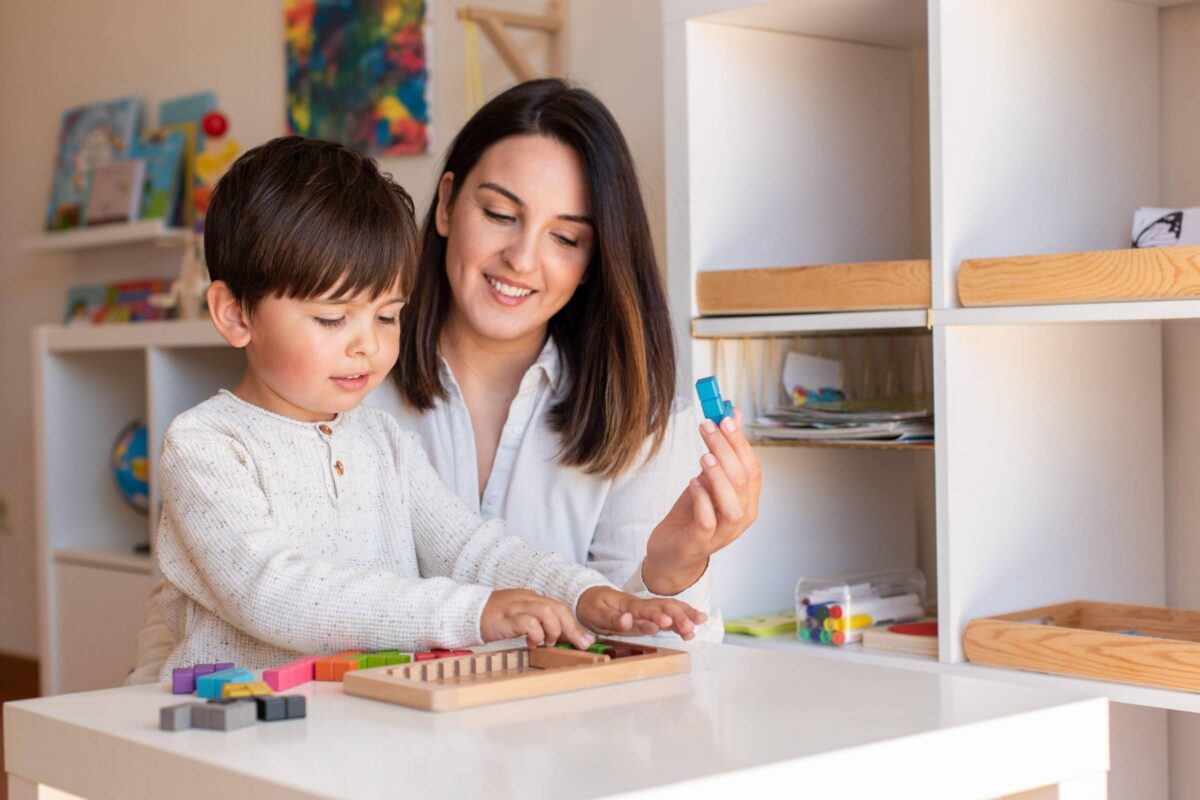
Montessori learning does not have to end when your child leaves the classroom. Many of the principles children experience at Montessori school can also become a natural part of family life.
Practicing Montessori at home does not mean turning your kitchen into a classroom or filling your house with specialized educational materials. In fact, some of the most meaningful Montessori activities use things your family already owns.
Simple experiences such as pouring a drink, putting away clothes, preparing a snack, watering a plant, or helping set the table give children opportunities to practice coordination, concentration, responsibility, and independence.
This guide explores practical ways parents can bring Montessori principles into everyday routines without trying to recreate school at home.
For families new to the philosophy, our guide to the Montessori Method explains the educational principles children experience in a Montessori environment.
What Does Montessori at Home Mean?
Montessori at home means creating age-appropriate opportunities for children to participate meaningfully in everyday life.
A few basic principles can guide parents:
- Make appropriate items accessible to your child
- Give children meaningful choices
- Encourage participation in everyday routines
- Allow time to complete age-appropriate tasks
- Keep spaces relatively orderly and predictable
- Provide activities that have a clear purpose
- Model how to complete new tasks
- Step in when help is genuinely needed rather than automatically doing everything for the child
The objective is not perfect independence. Young children still need guidance, reassurance, boundaries, and plenty of help.
Instead, parents can look for small moments when a child is capable of participating rather than simply having something done for them.
How to Create a Montessori-Friendly Home
You do not need to redesign your entire house to create a more Montessori-friendly environment. Start by looking at your home from your child’s perspective.
Can your child reach the things they are expected to use? Do they know where belongings go? Are there opportunities to participate in family routines?
Small adjustments can make everyday tasks easier for children to navigate.
Keep Everyday Items Within Reach
When appropriate and safe, place frequently used belongings where children can access them.
Examples might include:
- A low hook for a coat
- A small basket for shoes
- A reachable shelf for a few books
- Child-accessible art supplies
- A low drawer for appropriate dishes or utensils
- A designated place for toys and activities
Accessibility gives children opportunities to take responsibility for simple tasks without having to ask an adult for help every time.
Create Order Without Creating Rigidity
Montessori environments typically emphasize organization because knowing where things belong makes it easier for children to work independently.
At home, that might mean giving books, toys, art supplies, shoes, and clothing predictable places. You do not need a perfectly organized house. The goal is simply to make the environment understandable.
Instead of placing dozens of toys in one large bin, for example, a family might make a smaller selection of activities visible and easy to return when finished.
Offer Limited, Meaningful Choices
Choice is important, but unlimited choice can become overwhelming.
Instead of asking, “What do you want to wear today?” you might offer two weather-appropriate shirts. Instead of putting every available activity in front of a toddler, offer a smaller selection.
Children still experience the satisfaction of making decisions while parents maintain appropriate boundaries.
This idea reflects the balance between independence and structure found in a prepared Montessori classroom.
Practical Life: Some of the Best Montessori Activities Are Already in Your Home
One of the easiest ways to practice Montessori at home is through everyday household activities.
In Montessori education, Practical Life experiences allow children to participate in purposeful tasks while practicing skills such as coordination, concentration, sequencing, responsibility, and care for themselves and their surroundings.
At Alpine Montessori, Practical Life is also an important part of our Montessori curriculum and you may read more about it there.
At home, parents can create similar opportunities through ordinary routines.
Montessori Activities in the Kitchen
Depending on your child’s age and abilities, they might help:
- Pour water into a cup
- Wash fruits or vegetables
- Stir ingredients
- Peel a banana
- Spread a soft topping
- Carry napkins to the table
- Set out utensils
- Wipe the table
- Put appropriate dishes away
Food preparation can be especially engaging because children can see a clear purpose behind their work.
They are not completing an activity simply because an adult told them to practice a skill. They are contributing to something the family actually needs.
Montessori Cleaning Activities
Young children are often interested in the activities they see adults performing every day.
Age-appropriate tasks might include:
- Wiping up a spill
- Dusting a low surface
- Sweeping a small area
- Putting toys away
- Sorting laundry
- Matching socks
- Carrying clothing to a hamper
- Watering plants
The finished task does not need to meet an adult’s standard.
The experience of participating is often more valuable than getting the job done quickly.
Self-Care Activities
Daily routines also provide opportunities to practice caring for oneself.
Children can gradually participate in:
- Getting dressed
- Putting on shoes
- Brushing hair
- Washing hands
- Putting dirty clothing in a hamper
- Hanging up a coat
- Packing or unpacking belongings
The amount of assistance required will naturally change with age and development.
Montessori Activities at Home by Age
Parents often search for Montessori activities based on their child’s age. Development varies considerably from child to child, so age ranges should be treated as general guidance rather than deadlines.
The best activity is one that is safe, achievable with an appropriate amount of effort, and interesting to the individual child.
Montessori at Home for Infants
For babies, Montessori at home is less about planned “activities” and more about creating opportunities for safe movement, observation, communication, and exploration.
Parents might focus on:
- Safe floor space for movement
- Simple sensory experiences
- Talking and singing to their baby
- Looking at books together
- Giving babies time to observe their surroundings
- Providing a small selection of developmentally appropriate objects to explore
- Allowing movement rather than constantly positioning or entertaining the baby
Infants benefit greatly from responsive interaction with caregivers. There is no need to turn infancy into an academic program.
Families interested in how these ideas continue in an educational setting can learn more about Montessori infant care.
Montessori Activities for Toddlers at Home
Toddlers are often eager to imitate adults and participate in everyday routines.
Good Montessori activities for toddlers can include:
- Putting toys into baskets
- Carrying lightweight items
- Pouring with a small pitcher
- Matching socks
- Watering plants
- Washing produce
- Wiping a table
- Putting books back on a shelf
- Simple sorting activities
- Helping prepare snacks
A toddler may need an adult to demonstrate a task several times before attempting it independently.
Keep expectations realistic. A two-year-old helping clean a spill may create another small spill in the process. That does not make the activity unsuccessful.
Montessori Activities for Preschoolers at Home
As coordination and attention develop, preschool-age children can often participate in more complex household routines.
Ideas include:
- Setting the table
- Folding simple clothing
- Sorting laundry
- Preparing simple snacks
- Measuring ingredients
- Caring for plants
- Organizing personal belongings
- Cutting paper with child-safe scissors
- Drawing and early writing
- Counting objects during everyday activities
- Helping clean a work area after an activity
Parents can also incorporate language, mathematics, nature, art, and science into ordinary conversations without turning every experience into a lesson.
Count apples at the grocery store. Talk about the shapes you notice on a walk. Discuss what plants need to grow while working in the garden.
Learning can happen naturally throughout the day.
Montessori at Home for Kindergarten-Age Children
Older children can gradually take responsibility for multi-step activities and household contributions.
Depending on readiness, children might:
- Pack belongings with a checklist
- Help prepare part of a meal
- Organize a workspace
- Fold and put away clothing
- Care for a plant
- Follow a simple recipe with supervision
- Write a shopping list
- Count money during pretend or supervised real-life activities
- Help younger siblings with appropriate tasks
At this stage, practical independence can complement the academic, social, and emotional skills children need for school.
Our Kindergarten Readiness Guide explores those broader readiness skills in more detail.
How to Encourage Independence Without Expecting Too Much
One of the easiest Montessori principles to misunderstand is independence. Independence does not mean expecting a young child to manage everything alone.
A better approach is to ask: “What part of this task can my child reasonably do?”
A toddler may not be able to prepare lunch but may be able to carry a napkin to the table. A preschooler may not be ready to do an entire load of laundry but can sort light and dark clothing.
Breaking routines into manageable steps gives children opportunities to succeed.
Parents can also try showing rather than repeatedly explaining. Demonstrate the task slowly, give the child an opportunity to attempt it, and allow enough time for practice.
It can be tempting to step in immediately when a child struggles. When the situation is safe, giving them a little time to work through a manageable challenge can support persistence and problem-solving.
Do You Need Montessori Toys at Home?
No. Families do not need to purchase a house full of products labeled as “Montessori.”
Purpose matters more than marketing.
Simple puzzles, blocks, art supplies, books, sorting objects, child-sized household tools, and everyday Practical Life activities can all provide valuable learning experiences.
When choosing toys or activities, consider asking:
- Does the child have an active role?
- Is there something meaningful to explore or practice?
- Is it appropriate for the child’s current abilities?
- Can the child understand how to use it?
- Does it encourage concentration rather than constant stimulation?
Open-ended materials can also have value, particularly for creative expression and imaginative exploration.
The goal is not to make every object in your home conform to a label. It is to provide thoughtful experiences that allow your child to engage, explore, and participate.
Common Montessori-at-Home Mistakes
Bringing Montessori principles home should make family life more meaningful, not more stressful. A few common pitfalls are worth avoiding.
Doing Too Much for Your Child
Adults are usually much faster at putting on shoes, cleaning a table, or carrying a plate. But speed is not always the goal.
When time and safety allow, give children opportunities to complete manageable portions of everyday tasks themselves.
Offering Too Many Choices
More choice does not necessarily create more independence.
A smaller number of appropriate choices can make decision-making easier for young children.
Interrupting Concentration Unnecessarily
If a child is safely absorbed in building, drawing, sorting, reading, or another purposeful activity, there may be no need to immediately redirect them.
Periods of focused engagement give children opportunities to practice concentration.
Expecting Perfection
A child’s folded towel will not look like an adult’s. Water may spill during pouring practice. Socks may end up in the wrong drawer.
Learning involves repetition.
Focus on developing the skill rather than producing a perfect result.
Trying to Turn Home Into School
Parents do not need lesson plans for every hour of the day.
Home provides something uniquely valuable: real family life.
Cooking, cleaning, gardening, getting dressed, caring for belongings, talking together, reading, and helping other people all provide opportunities for children to learn.
10 Simple Montessori Activities to Try at Home This Week
If you want to start small, choose one or two activities that fit naturally into your family’s existing routine.
- Let your child pour their own water from a small pitcher.
- Create a low hook where they can hang their coat.
- Ask them to match clean socks.
- Let them wash a piece of fruit before snack time.
- Give them a cloth to wipe up a small spill.
- Ask them to water a houseplant.
- Invite them to place napkins on the dinner table.
- Create a clearly defined place for books or favorite activities.
- Let them choose between two appropriate outfits.
- Invite them to help prepare a simple snack.
You do not need to introduce all ten at once. Start with an activity your child already shows interest in and build from there.
Connecting Montessori at Home and School
Children benefit when the adults in their lives recognize their growing capabilities.
At home, that may mean having time to put on a coat, carry a plate, help prepare food, or clean up after an activity.
In a Montessori school, those same qualities are supported within a carefully prepared educational environment. Children have opportunities to make purposeful choices, use hands-on materials, care for their classroom, develop concentration, and progress toward increasingly complex academic work.
The settings are different, and they should be.
Parents do not need to duplicate the classroom. Instead, home and school can complement each other by giving children consistent opportunities to participate, practice, explore, and gradually take on greater responsibility.
Experience Montessori Learning at Alpine Montessori
Montessori at home can introduce children to meaningful routines, purposeful activities, and age-appropriate responsibility. A Montessori classroom builds on those principles within an educational environment specifically prepared to support children’s academic, social, emotional, and physical development.
Alpine Montessori serves families through our Sparta Montessori School and Oak Ridge Montessori School, with programs from infancy through kindergarten.
If you’re interested in seeing how hands-on learning, Practical Life, independence, and individualized education come together in the classroom, contact Alpine Montessori to schedule a visit and find the right program for your child.
FAQ
How do I start Montessori at home?
Start with your child’s everyday environment rather than buying new materials. Give commonly used belongings predictable places, provide safe access to age-appropriate items, and invite your child to participate in simple household routines such as dressing, cleaning, food preparation, and caring for belongings.
What are good Montessori activities for toddlers at home?
Simple Practical Life activities are a good starting point. Toddlers can practice pouring, sorting, carrying lightweight objects, watering plants, putting toys away, washing produce, matching socks, and wiping tables with appropriate adult supervision.
Do I need Montessori toys to practice Montessori at home?
No. Many Montessori-inspired experiences use ordinary household items. Books, puzzles, blocks, art materials, cooking tools, cleaning supplies sized appropriately for children, and everyday household routines can all provide meaningful opportunities to learn.
What age can you start Montessori at home?
Montessori principles can be applied from infancy by creating a safe environment for movement, observation, interaction, and exploration. Activities should change as a child’s abilities develop rather than following a rigid age-based schedule.
Can I use Montessori at home if my child does not attend a Montessori school?
Yes. Families can use principles such as age-appropriate independence, purposeful activity, accessible environments, limited choices, and respect for concentration regardless of where a child attends school. Parents interested in a formal Montessori learning environment can also explore the Montessori Method to understand how these ideas are applied in the classroom.